Placings matter
A finish order isn’t just a number on a results sheet — it determines who advances, who qualifies, who stands on the podium, and who goes home. For some races, the margins are wide enough that this never becomes a question. Often, a finish comes down to hundredths of a second, and in those moments, the result may carry real consequences.
In competitive swimming, the touchpad is the final word on results. It’s a proven, well-understood system that has served the sport reliably for decades. When a Referee reviews a race, their process reflects that trust: they observe the finish, note their own placings, and check them against the official touchpad result. If there’s a discrepancy, the touchpad result stands, unless a known malfunction, breakdown or failure has occurred.
But what happens when a touchpad malfunction is below the accepted error threshold?
Video challenges the official result
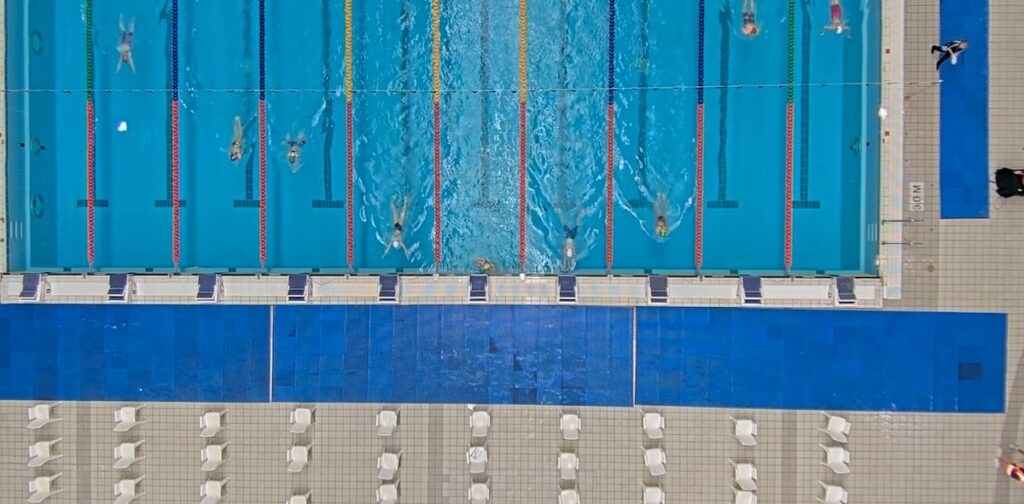
At a recent meet, the race finish order determined from touchpad times differed from the finish order determined by 100fps video.
Play the video below and note the finish order. To move frame by frame, press pause, then SHIFT < or > to move backwards or forwards. Select full screen mode for greater clarity. Lane 0 is on the far right and 9 on the far left. The original 100fps video has been rendered here at a reduced rate.
The video shows that one touchpad (Lane 5) triggered late, but the discrepancy was less than the ±0.30s tolerance used to decide whether a backup time should override the pad. Because it fell inside that tolerance, the touchpad times and finish order stood as the official result.
The result was queried by the 4th-placed athlete’s representative. The Referee reviewed the query and confirmed the original, pad-based result. As a consequence, that athlete did not progress to the next competition.
Spot the difference
| Lane | Pad time (s) | Finish order (pad) | Video time (s) | Finish order (video) | Video–pad difference (s) |
|---|---|---|---|---|---|
| 0 | 58.48 | 8 | 58.52 | 8 | +0.04 |
| 1 | DSQ | DSQ | |||
| 2 | 50.46 | 3 | 50.38 | 4 | -0.08 |
| 3 | 49.66 | 2 | 49.61 | 2 | -0.05 |
| 4 | 44.14 | 1 | 44.07 | 1 | -0.07 |
| 5 | 50.51 | 4 | 50.26 | 3 | -0.25 |
| 6 | 52.86 | 5 | 52.88 | 5 | +0.02 |
| 7 | 52.95 | 6 | 52.95 | 6 | 0.00 |
| 8 | 56.92 | 7 | 56.94 | 7 | +0.02 |
| 9 | NS | NS |
Bolded values highlight lanes 2 and 5, where the pad and video finish orders diverge. Lane 5’s pad time was 0.25s slower than video — within the ±0.30s tolerance, so it stood as official — swapping the 3rd/4th finish order between lanes 5 and 2.
The standard operating procedure was correctly followed
In our view, the referee handled this correctly, by the book. Touchpad times are presumed accurate unless there is evidence of “any malfunction, break-down, or failure,” and the international standard for identifying that is a difference of ±0.30s between pad and backup timing. Nothing here fell outside that standard, so nothing here breached procedure.
It’s difficult to say how often this happens, because timing systems, including our own, are typically configured to flag differences at the ±0.30s threshold, not below it. Smaller discrepancies simply aren’t routinely monitored, and tend to only surface when someone watching closely enough raises them. Anecdotally, we see this more often at meets involving less experienced swimmers, or where less maintained touchpads are in use.
Without systematic monitoring below the ±0.30s level, nobody can say with confidence how frequently finish order is quietly affected.
Video gives confidence
This is where video-assisted verification earns its place — not as a replacement for the touchpad, but as an independent check. Where a touchpad reports a single moment of contact, video captures the full approach and touch, frame by frame, giving officials something the pad alone can’t: a visual record they can review whenever a result is close, contested, or simply worth a second look.
It doesn’t ask Referees to distrust the touchpad, or to change how they apply the rules. It gives them — and the athletes affected by close calls — a way to see what actually happened, even within tolerances too fine for the pad-versus-backup rule to catch.
Touchpads aren’t going anywhere, nor should they. But confidence in a finish order shouldn’t depend on whether a discrepancy happened to be large enough to trip a threshold. Pairing the pad with video gives officials, athletes, and coaches the same thing everyone wants from a result: the ability to know it’s right.
Olly Pad Check verifies every finish
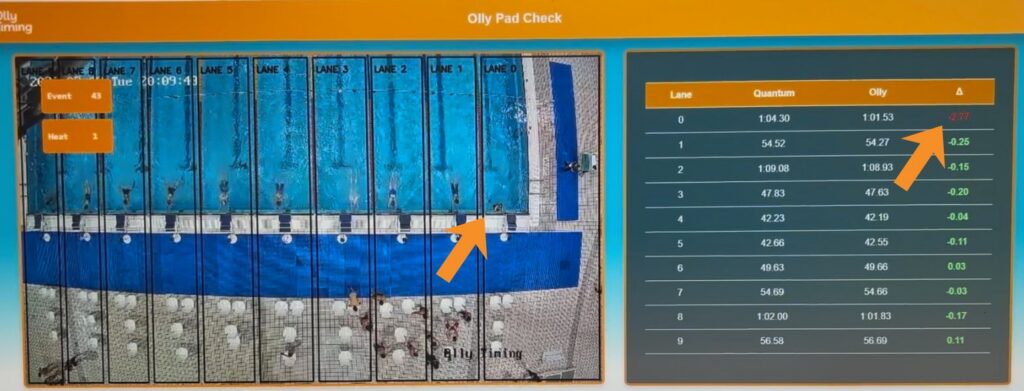
Olly Pad Check routinely checks every pad time against video with 2 independent verifications. The video snapshot summary (left) shows the position of the swimmer at the time that the pad recorded a touch. The mathematical difference calculation (right) shows out of tolerance discrepancies in red.
In the image above lane 0 appears to have already finished the race (left) and the pad time is 2.77s slower than video (right). This is a soft touch and the pad time will be replaced by video backup time.